- Home ›
- Construction ›
- Building with Bamboo
Building with Bamboo
Building with bamboo is commonplace in some eastern countries and becoming more widely used in the western world as builders and architects discover how to utilise it's versatility and flexibility as a fabrication material.
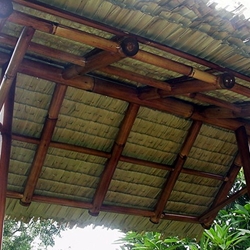
It has grown to be an essential material in creation of architectural structures in earthquake regions.
An example of its flexibility to endure earthquakes can be seen in the 1992 earthquake in Limon, Costa Rica.
The housing that stood against the earthquake were the buildings from the National Bamboo Project where the lightweight and flexible cane left the buildings intact from the violent shaking.
As well as increasing in use as a primary construction material for building with bamboo because it is one of the strongest materials available, it is also fastly becoming highly fashionable in interior design, flooring, furniture, and for decorative purposes.
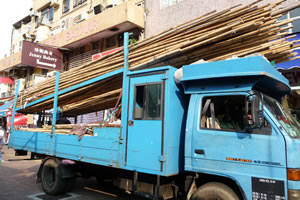
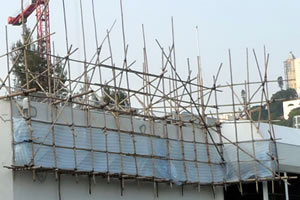
Bamboo being transported in Hong Kong / Bamboo Scaffolding in Hong Kong
Strength
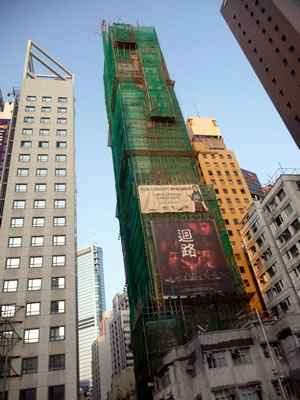
Bamboo Scaffolding
This material is so aesthetically pleasing that it can be used in interior design and furnishings, yet it is also so strong it can be used for an integral construction material.
In many countries around the world, particularly countries with tropical climates where forests of giant bamboos are able to grow and be harvested, there is a long tradition to using bamboos for construction.
The tensile strength of bamboos is 28,000 per sq inch in comparison to 23,000 per sq inch for the more traditional western material of steel.
The strength, beauty, and sustainability, of these construction products has led to higher levels of appreciation in their versatility when applied to the structural design of modern day construction projects around the world.
Scaffolding
Bamboo is seriously strong and flexible and for those reasons is used extensively for construction and scaffolding in countries such as Hong Kong and has been for a long time! For more, please visit my page on Bamboo Scaffolding
Construction Technology
Construction technology has improved how bamboos can be used in the contemporary erection of buildings and structural systems.
Examples are; joints, treatments, roofing, flooring, tiles, and even concrete and a type of plasterboard.
In India, significant research into corrugated mat roofing sheets by the Indian Plywood Industries Research and Training Institute, and concrete by the Bamboo Development Agency, is really helping push this material into an exciting future for building with bamboo.
Timber Replacement
With timber resources getting scarce and being really expensive, bamboos are providing a valid, environmentally friendly, fast growth return, alternative to wood in construction materials.
Several types of boards made by a process of splitting and gluing are now available. For building with bamboo boards you may be able to source any of the following; mat boards, ply boards, and strip boards.
- The mat boards is where the material is sliced into slivers then woven and hot pressed to produce a plywood of superior strength and life span.
- Ply boards are made up of mats and slivers, also hot pressed to produce the ply.
- Strip boards are made using heat techniques to flatten round canes of bamboos which are then hot pressed and glued.
The resulting strip boards are larger than can be produced from timber and can be used for a variety of construction needs such as truck bodies and containers.
Books
For a selection of books about bamboo and building, visit Bamboo Building Books.
Road Construction
Building with bamboo techniques and materials have been applied in reinforcing roads in India.
The success of these types of projects will further the credibility of bamboos in the construction industry.
Green Building Materials
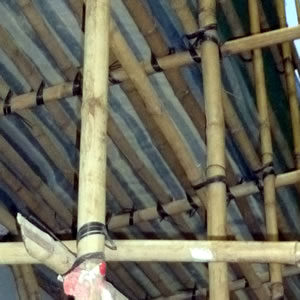
Scaffolding
With all the concerns about global warming and the trend towards using materials to construct buildings that are considered to be 'green', or 'environmentally friendly', building with bamboo can only increase in popularity in the future.
To classify a structure as being environmentally friendly would include using materials that do not have, or are less likely to have, a detrimental effect on our environment in a global context.
Choosing materials that have a short renewable time period in comparison to other natural resources such as timber should also be considered.
Building with bamboo falls into the category of being environmentally friendly as the plants are quick to mature in comparison to trees.
The 'green' category increases considerably if the plants are grown in the country they will be used in due to the reduction in travel to destination of use. It would be great if bamboos were grown and harvested in the UK for example, instead of transporting them from around the world.
Also in this category, consider the environmental cost of the manufacturing processes. We need to meet rules in our manufacturing techniques so as to not consume fossil fuels, pollute the atmosphere, or extract resources from the earth in processing products that would otherwise not have a detrimental effect on our environment.
Other building with bamboo pages...